Many boutique businesses begin online with a simple process:
Instagram → WhatsApp → Customer Enquiry → Order Confirmation → Payment
For a new boutique, this can be a practical way to start.
But as the number of products, customers and orders increases, managing everything manually can become more difficult.
Customers may start asking:
“Can I order directly from your website?”
That is where a full eCommerce website with online payment functionality can become useful.
Instead of using your website only as a product catalogue, you can allow customers to browse products, add them to a cart, enter their details, choose a payment method and complete their order online.
What Is a Payment Gateway eCommerce Website?
A payment gateway eCommerce website is an online store that allows customers to complete purchases through the website.
A typical customer journey looks like this:
Instagram / Google → Website → Product Page → Cart → Checkout → Payment → Order Confirmation
The website handles more of the purchasing process instead of requiring the customer to contact you for every order.
Depending on the business requirements, the website can include:
- Product catalogue
- Product categories
- Product search
- Filters
- Shopping cart
- Customer checkout
- Online payment gateway
- Order confirmation
- Customer information
- Order management
- Stock management
- Discount and coupon functionality
The exact features depend on how your boutique operates.
Why Would a Boutique Move to Online Payments?
A WhatsApp enquiry system can work well when order volumes are manageable.
But imagine receiving dozens of enquiries every day.
A customer asks about a product.
Another customer wants to know the price.
Someone else wants to confirm the available size.
Another person wants to place an order.
You then need to collect delivery information, confirm payment and keep track of every order.
As the number of orders increases, a manual process can become harder to manage.
An eCommerce website can move many of these steps into one structured system.
The customer can complete much of the process independently.
Customers Can Shop Without Waiting for a Reply
One advantage of online checkout is convenience.
Suppose a customer discovers your boutique late at night.
With a WhatsApp enquiry model, they may send a message and wait for a response.
With an eCommerce website, they can:
- Browse your products
- Check prices
- Select a size
- Select a colour
- Add products to the cart
- Enter their delivery details
- Choose an available payment method
- Complete the order
This allows your online store to accept orders even when you are not actively responding to messages.
How the Online Shopping Process Works
A well-structured boutique eCommerce website can make the customer journey straightforward.
Step 1: Discover the product
A customer may find your boutique through Instagram, Google, Facebook, an advertisement or another channel.
Step 2: Visit the product page
They can view photographs, price, sizes, colours, fabric information and other product details.
Step 3: Add the product to the cart
The customer selects the required options and adds the product to their shopping cart.
Step 4: Checkout
They provide the information required for delivery and select the available payment method.
Step 5: Payment
The customer completes payment through the integrated payment system.
Step 6: Order confirmation
The website records the order and provides confirmation to the customer.
The boutique owner can then process the order from the website’s administration system.
What Should a Boutique eCommerce Product Page Include?
The product page remains one of the most important parts of the website.
Customers should be able to understand the product before adding it to their cart.
Depending on what you sell, the page can include:
- High-quality product photographs
- Product name
- Price
- Product description
- Available sizes
- Available colours
- Fabric information
- Product specifications
- Availability status
- Size information
- Care instructions
- Delivery information
- Return and exchange information
- Add to Cart button
- Buy Now option where appropriate
The goal is to provide enough information for customers to make a purchase decision without needing to ask basic questions through WhatsApp.
Product Variations Are Important for Fashion Businesses
Boutique products often have multiple variations.
A kurthi may be available in different:
- Sizes
- Colours
- Patterns
A saree may have different colours or design variations.
An eCommerce website can organize these options directly on the product page.
Instead of asking:
“Do you have this in Medium?”
the customer can select Medium from the available options.
Similarly, available colours can be presented as selectable options.
This makes the purchasing process more structured.
Shopping Cart Makes Multi-Product Orders Easier
A customer may not want to purchase only one product.
They might want:
- Two sarees
- A kurthi and matching accessory
- Multiple products from a new collection
- Products for different family members
With a shopping cart, customers can continue browsing and add multiple products before completing one checkout.
This is different from handling each product as a separate WhatsApp conversation.
Online Payment Gives Customers a Direct Checkout Experience
Once the customer reaches checkout, an integrated payment gateway can allow them to complete the payment through the payment methods supported by your chosen gateway and business setup.
The exact payment methods available depend on the payment provider and configuration.
The important difference is that the payment step becomes part of the website’s checkout process.
Instead of:
Customer → WhatsApp → Payment discussion → Payment confirmation → Manual order entry
the process can become:
Customer → Cart → Checkout → Payment → Order recorded
This can reduce the number of manual steps involved in processing an order.
What Happens After a Customer Places an Order?
A complete eCommerce website can record important order information in the website’s administration area.
Depending on the setup, you may be able to view:
- Order number
- Customer name
- Contact information
- Delivery address
- Products ordered
- Quantity
- Order value
- Payment information
- Order status
This gives the business a centralized place to manage online orders.
Order Management Becomes More Organized
When orders are handled manually, it can be easy to lose track of conversations.
One customer may have ordered through WhatsApp.
Another may have contacted Instagram.
Someone else may have called.
An eCommerce website can bring website orders into a structured order management system.
Depending on the platform and configuration, you can manage statuses such as:
- Pending
- Processing
- Completed
- Cancelled
- Refunded
The exact workflow can be customized around the business process.
Stock Management Can Become Important as Orders Increase
Inventory becomes more complicated when a boutique has many products and variations.
For example, a particular kurthi may have:
Small — 2 available
Medium — 4 available
Large — 1 available
A structured eCommerce system can help manage stock quantities for products and variations.
Depending on the setup, stock levels can be adjusted as orders are processed.
This can make it easier to keep the online catalogue aligned with actual availability.
Customers Can Continue Using WhatsApp Too
Moving to eCommerce does not mean WhatsApp has to disappear.
You can continue using WhatsApp as part of the customer support process.
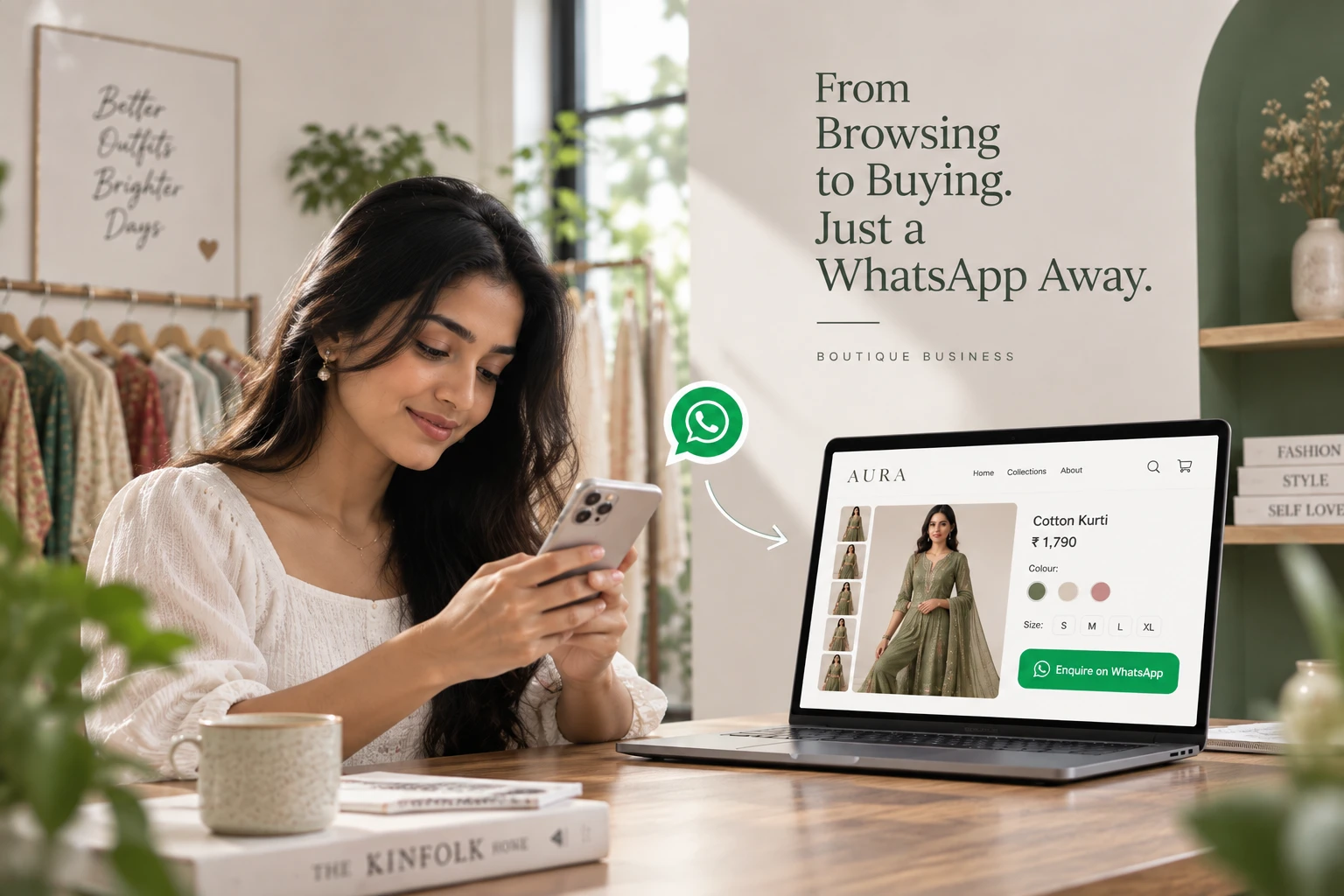
For example, a product page can have:
Add to Cart
as the main purchasing option, while also offering:
Enquire on WhatsApp
for customers who have questions before purchasing.
WhatsApp can remain useful for:
- Product questions
- Size assistance
- Custom requirements
- Order support
- Customer communication
The website handles structured purchases while WhatsApp can support conversations that require personal assistance.
Online Payments Do Not Mean You Need to Abandon Cash on Delivery
Depending on the business model and delivery setup, a boutique may choose to offer more than one payment option.
For example, a store may provide online payment along with Cash on Delivery where appropriate.
The available options should be decided based on the business, delivery areas, customer preferences and operational requirements.
The important point is that your website can be designed around the payment methods your business actually wants to support.
Discount Coupons and Offers
Fashion businesses frequently run promotions.
An eCommerce website can support promotional functionality such as:
- Discount coupons
- Collection-based offers
- Percentage discounts
- Fixed-value discounts
- Seasonal promotions
- Special campaign offers
The exact functionality depends on the eCommerce platform and configuration.
This can make it easier to run promotions without manually calculating every customer’s order total.
Customers Can Find Products More Easily
A complete eCommerce website can organize products into categories and collections.
For example:
- Sarees
- Kurthis
- Salwar Sets
- Lehengas
- Western Wear
- Kids Wear
- New Arrivals
- Festive Collections
- Wedding Collections
- Sale
You can also provide filters based on characteristics relevant to your products.
For example:
- Price
- Size
- Colour
- Fabric
- Occasion
- Collection
- Availability
This becomes particularly useful as your product catalogue becomes larger.
From Instagram Discovery to Website Checkout
Social media can still play an important role in driving customers to your store.
For example:
Instagram Reel → Product Interest → Website → Product Page → Cart → Checkout → Payment
Your Instagram content creates interest.
Your website provides the complete product information.
The shopping cart allows customers to collect their selected products.
The checkout handles the purchase process.
The payment gateway completes the payment step.
Each platform has a different role in the customer journey.
Why Not Build a Payment Website From Day One?
You can.
But that does not mean every new boutique needs a complete eCommerce system immediately.
If you are still testing products, receiving only a small number of enquiries and managing orders comfortably through WhatsApp, starting with a simpler website may make more sense.
A full eCommerce system becomes more relevant when you have a genuine need for:
- Online checkout
- Online payments
- Shopping cart
- Structured order management
- Inventory management
- Higher-volume online sales
The right time to move to eCommerce depends on your business rather than simply how long you have been operating.
WhatsApp Enquiry Website vs Payment Gateway eCommerce Website
Both models can be useful at different stages.
| Feature | WhatsApp Enquiry Website | Payment Gateway eCommerce Website |
|---|---|---|
| Product catalogue | Yes | Yes |
| Product details | Yes | Yes |
| WhatsApp enquiries | Yes | Can be included |
| Shopping cart | Not required | Yes |
| Online checkout | Not required | Yes |
| Online payment | Not required | Yes |
| Website order management | Limited | Yes |
| Inventory management | Optional / limited | Can be integrated |
| Best suited to | Businesses starting with catalogue-based enquiries | Businesses ready for direct online sales |
The decision should be based on your current sales process, order volume, product catalogue and future requirements.
WooCommerce Can Be Used for Boutique eCommerce Websites
For businesses using WordPress, WooCommerce is one option for building a complete online store.
It can provide functionality for:
- Products
- Product variations
- Shopping carts
- Checkout
- Orders
- Customers
- Coupons
- Stock management
- Payment integrations
The actual setup depends on the business requirements and the payment, shipping and other services being integrated.
For a deeper overview, see:
WooCommerce Development Services in Kerala.
Your eCommerce Website Should Match Your Boutique
An online fashion store should not simply look like a generic shopping website.
The design can reflect:
- Your brand identity
- Your product style
- Your target customers
- Your collections
- Your photography
- Your pricing structure
- Your customer journey
The presentation of a premium designer boutique may be very different from a casual fashion store or a traditional ethnic-wear business.
The website should support the identity you are trying to build.
Mobile Experience Is Especially Important
Many customers discover fashion products through their smartphones.
That means your eCommerce website should be designed to work properly across mobile devices.
Customers should be able to:
- Browse categories
- View product photographs
- Select product variations
- Add products to the cart
- Complete checkout
- Make payment
A technically functional website is not enough if the purchasing process becomes difficult on a smaller screen.
The mobile shopping experience should be considered from the beginning of the design and development process.
Security and Payment Integration Matter
When a website handles customer information and online transactions, security should be treated as an important part of development.
The website should use appropriate security practices, HTTPS/SSL, secure payment integration and a properly configured hosting environment.
Payment details should be handled through the payment provider’s supported payment infrastructure rather than being unnecessarily stored on the website.
The exact security requirements depend on the technology stack, payment provider and business setup.
Analytics Can Help You Understand Your Online Store
Once your website starts receiving visitors and orders, analytics can provide useful information about customer behaviour.
Depending on the tools integrated with your website, you can understand things such as:
- Where visitors are coming from
- Which pages receive attention
- Which products are viewed frequently
- Which marketing channels generate traffic
- How customers move through the website
- Where customers leave the purchasing process
This information can help you identify areas of the website that may need improvement.
Do You Need Every eCommerce Feature?
Not necessarily.
There is a difference between having a complete eCommerce website and adding every available feature.
Your boutique may not need:
- Customer loyalty programs
- Complex automation
- Advanced recommendation engines
- Multiple warehouse systems
- Complex ERP integrations
at the beginning.
The better approach is to identify the features that solve real business problems.
You can then introduce additional functionality when there is a genuine need for it.
When Should a Boutique Consider Moving to Full eCommerce?
A full eCommerce website may be worth considering when:
- You are receiving a growing number of online orders
- Customers frequently ask to order directly through your website
- Manual order management is becoming difficult
- You have a large product catalogue
- You want customers to complete purchases without waiting for a reply
- You want to accept online payments
- You need better order organization
- You want to manage product stock digitally
- You are planning to expand your online sales
These are business decisions rather than technical requirements.
Why ENVINTO Builds Customized eCommerce Websites
At ENVINTO, we understand that a boutique’s website needs to reflect how the business actually operates.
Some businesses may start with WhatsApp enquiries.
Others may already be ready for online payments and complete checkout.
We first understand your products, customers, order process, payment requirements and future plans before deciding how the website should be structured.
Depending on the project, we can develop a customized WordPress and WooCommerce solution with the required product, checkout, payment and management functionality.
Our WooCommerce development services can be planned around the specific requirements of your boutique rather than forcing the business into an unnecessary feature-heavy setup.
From WhatsApp Orders to a Complete Online Store
A boutique does not have to choose between WhatsApp and eCommerce as if they are completely separate systems.
They can represent different stages of the same customer journey.
You may begin with:
Instagram → Website → WhatsApp Enquiry
As your business grows, the process can evolve into:
Instagram → Website → Cart → Checkout → Online Payment → Order Management
WhatsApp can continue to support customers who need personal assistance, while the website handles customers who prefer a direct online purchase.
The important thing is to build the system around how your customers actually buy.
Ready to Build an Online Store for Your Boutique?
If your boutique is ready to move beyond product enquiries and start accepting online orders, a payment gateway eCommerce website can provide a more complete way to sell online.
Tell us about your products, current order process, payment requirements and how you want your online store to work.
Talk to ENVINTO about your boutique eCommerce website and explore a solution designed around your business.
Related Guides: